
SHERLOCK Final Event Highlights
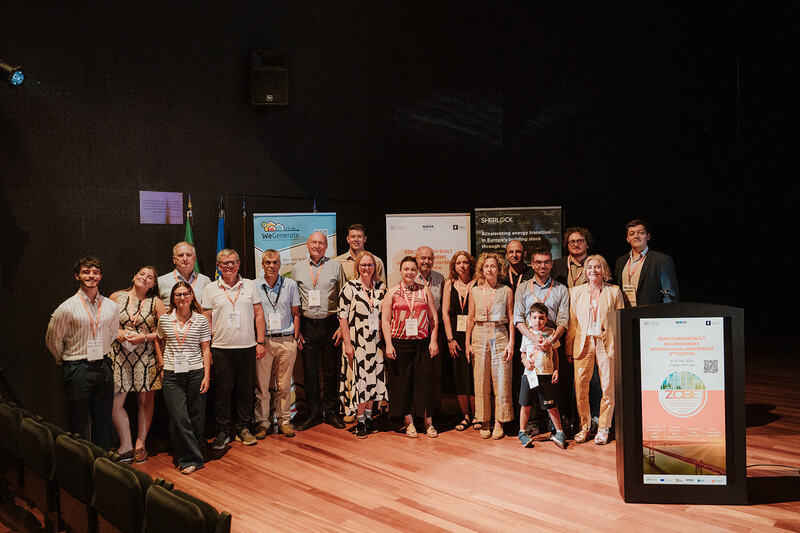
On 10 July 2026, the SHERLOCK Final Event took place in Lisbon as part of the 2nd International Zero Carbon Built Environment (ZCBE) Conference (9-10 July), co-organised by LNEG in partnership with NOVA University and the University of Nottingham, and supported by the European projects SHERLOCK, WeGenerate and SOLACE.
Bringing together researchers, industry experts and professionals from across disciplines, the conference provided a unique opportunity to exchange knowledge and discuss pathways towards a more sustainable, resilient and low-carbon built environment. Within this inspiring setting, SHERLOCK held its Final Event, celebrating the project's achievements and exploring the role of education, innovation and stakeholder collaboration in accelerating Europe's energy transition.
Reflecting on SHERLOCK's Journey
The SHERLOCK Final Event was opened by Mattia De Rosa (Università degli Studi di Genova), who presented the project's vision, key achievements and long-term impact. His speech highlighted SHERLOCK's innovative educational programmes and micro-credential approach, designed to equip current and future professionals with the skills needed to support Europe's transition towards more sustainable and energy-efficient buildings.
Amy Fahy (Maynooth University) followed by sharing the Irish experience of stakeholder co-creation and the development of the Knowledge Centre. Her presentation showcased the participatory methodology developed by Three o'clock and demonstrated the importance of involving stakeholders throughout the educational design process to ensure that training programmes reflect real-world needs and challenges. Together, these presentations illustrated one of SHERLOCK's core principles: achieving meaningful change requires bringing together expertise from academia, industry, policymakers and citizens.
Innovation and Collaboration for Sustainable Buildings
The technical sessions explored some of the most pressing challenges and opportunities facing Europe's energy transition.
Paulo Ferrão opened the discussions by highlighting one essential factor: trust. Achieving the European Union's climate objectives requires more than innovative technologies—it requires the active involvement of citizens, stakeholders and investors. Drawing on the Climate City Contracts initiative, he explored the challenges cities face and emphasised the importance of governance, integration, technical capacity and multi-stakeholder collaboration. One key message emerged clearly from his presentation: the most effective way to engage people is to demonstrate successful examples.
The discussions then turned towards technological innovation. Christos Markides presented the latest developments in solar PV-X technologies, including high-performance photovoltaic-thermal systems, innovative collector designs and strategies to improve efficiency and reduce heat losses. Particular attention was given to the market readiness and maintenance requirements of these technologies, highlighting both commercially available solutions and those progressing towards market deployment.
Carlos Vargas Salgado showcased practical applications of photovoltaic systems and microgrids and their contribution to the energy transition, while Maria Mandalaki presented a case study from Chania, Greece, demonstrating how the integration of photovoltaic panels and geothermal heat pumps can significantly improve buildings' heating and cooling performance.
Skills Development at the Heart of the Energy Transition
The afternoon technical sessions expanded the discussion by addressing a wide range of topics supporting Europe's climate ambitions, including urban cooling, renewable energy communities, district heating, skills development and European energy policies. Through practical case studies from Italy, Lithuania and Spain, speakers demonstrated how innovative technologies, stakeholder engagement and supportive policy frameworks can accelerate the transition towards more sustainable and energy-efficient buildings and communities.
Presentations also highlighted valuable experiences from the LIFE Resskill project and reinforced the importance of continuous learning and upskilling in supporting Europe's decarbonisation.
Looking Towards the Future
The SHERLOCK Final Event provided an opportunity not only to celebrate the project's achievements but also to reflect on the challenges and opportunities that lie ahead. From stakeholder co-creation and innovative educational programmes to cutting-edge technologies and policy frameworks, the event demonstrated that building a sustainable future requires an integrated approach that places people, skills and collaboration at its centre.
We would like to warmly thank all speakers and participants for contributing to these inspiring discussions as well as the LNEG team and the Nova Lisboa University for hosting us!
.jpg)
Did you miss our event? You can watch it online!
If you have been with us, our fantastic photographer has caught you somewhere in the venue! Find all the photos in this link!


